South Korea's Ultimate Cheat Code: How 'Pali-Pali' Culture Hijacked AI
Why are 70-year-old Koreans trading AI prompts at cafes? Driven by "pali-pali" (speed) and FOMO, South Korea is in an AI Gold Rush. But are we making real profit, or just swinging shiny pickaxes in an empty mine? Discover the uncomfortably real paradox of Korea's AI obsession.

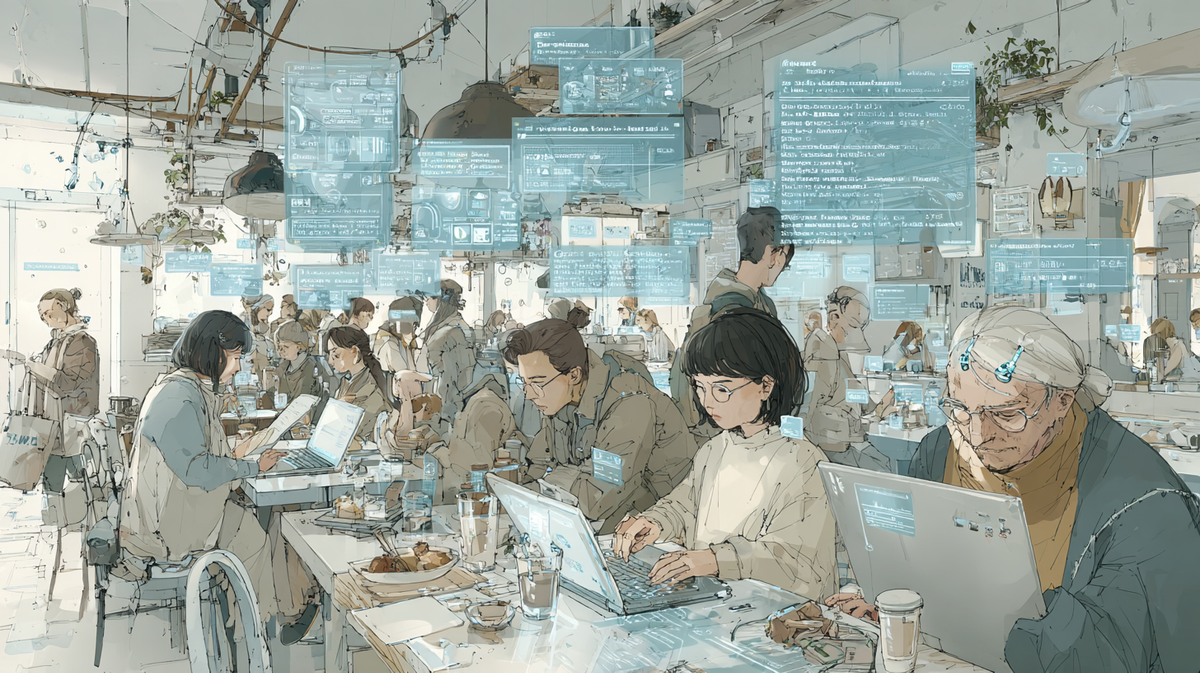
On an ordinary weekday afternoon in a neighborhood café in Seoul, something faintly surreal is happening.
This is not a glass-walled coworking space in Silicon Valley. There are no founders in black T-shirts pitching “the future of productivity.” Instead, a few people in hiking jackets—some well into their seventies—sit beside parents who have just dropped their children off at school. Between sips of Americano, the conversation drifts into territory that would have sounded absurd only a few years ago.
“Don’t struggle with that. Just ask AI to write it for you.”
“Really? What prompt did you use?”
In Korea, generative AI is no longer a shiny toy reserved for engineers, consultants, or teenagers with too much screen time. It has slipped into daily life with the casual intimacy of a kimchi recipe, a real-estate tip, or neighborhood gossip. Prompt advice now travels through cafés, KakaoTalk rooms, Instagram reels, YouTube comments, and family group chats.
Global reports may describe South Korea as one of the fastest adopters of AI in the world. They may point to broadband penetration, smartphone culture, education fever, or national competitiveness. All of that matters.
But the real explanation is simpler, stranger, and far more Korean.
This is the country where people press the elevator “close” button as if negotiating with fate. The country where food delivery can feel slow if it takes more than twenty minutes. The country where convenience stores sell not just snacks, but an entire philosophy of optimized survival.
Korea did not merely adopt AI.
Korea looked at AI and thought: Finally. A machine that understands us.
AI as the Ultimate “Pali-Pali” Device
The Korean phrase “pali-pali” means “quickly, quickly.” But translating it as speed misses the point.
Pali-pali is not just a tempo. It is a cultural operating system.
It is the expectation that things should move faster than they reasonably can. It is the social muscle memory formed by decades of compressed modernization, fierce competition, dense cities, demanding workplaces, and a national talent for turning inconvenience into a personal insult.
So when generative AI arrived, many societies framed it as a philosophical dilemma. Will it replace humans? Is it ethical? Can it think? What does authorship mean?
Koreans, being practical, asked a different question:
“Can it write this awkward email to my boss in three seconds?”
And AI said yes.
That was enough.
For many Koreans, AI is not first experienced as a grand technological revolution. It is experienced as a cheat code for the small emotional taxes of everyday life: writing polite emails, summarizing long documents, making captions, drafting apology messages, preparing presentations, translating phrases, naming businesses, turning blunt thoughts into socially acceptable language.
In other words, AI became a “K-etiquette injector.”
A Korean office worker might type a brutally simple message:
“Send me the file by today.”
Then ask AI:
“Please rewrite this politely, warmly, with a soft greeting and no chance of sounding rude.”
The result appears instantly, padded with courtesy, seasonal weather references, and just enough emotional insulation to survive corporate Korea.
What once took ten minutes of careful social calibration now takes three seconds.
This is not laziness. It is liberation from micro-labor.
At least, that is how it feels at first.
The Copy-Paste Gold Rush
Open Instagram, Threads, or YouTube in Korea today, and you will find an endless stream of “magic prompts.”
Prompts that supposedly make you rich.
Prompts that create viral content.
Prompts that summarize books.
Prompts that write business plans.
Prompts that make you look smarter in meetings.
Prompts that promise to turn anyone, instantly, into a strategist, designer, marketer, tutor, analyst, or creator.
People copy them. Save them. Share them. Slightly modify them. Forget where they came from. Use them anyway.
The old Korean instinct was to collect certifications, test scores, language skills, and investment tips. Now, people collect prompts.
Behind this frenzy sits a familiar engine: FOMO.
Fear of Missing Out is global. But in Korea, it has a sharper edge. In a society where trends move fast and competition starts early, falling behind is not merely inconvenient. It feels existential.
If a YouTube video says that a retiree is earning millions of won a month with AI-generated content, someone will believe it. Or at least believe that not trying might be dangerous.
If a Threads post claims that “people who don’t use AI now will be obsolete in three years,” it does not sound like a dramatic prediction. It sounds like a weather forecast.
So everyone starts digging.
Students use AI. Office workers use AI. Small-business owners use AI. Parents use AI. Retirees use AI. People who barely figured out cloud storage are suddenly asking ChatGPT to create curriculum plans, product descriptions, scripts, slogans, and side-hustle ideas.
Korea has entered its AI Gold Rush.
But as with every gold rush, the question is not who is holding a pickaxe.
The question is who owns the mine.
Are We Making Capital—or Just Making Content?
This is where the comedy becomes uncomfortable.
During the California Gold Rush, the people who reliably got rich were often not the miners. They were the people selling shovels, denim, maps, transport, lodging, and dreams.
The same pattern is visible in Korea’s AI fever.
Many people are not building new companies, new intellectual property, new systems, or durable economic leverage. They are buying courses about how to use AI. Watching videos about how to monetize AI. Downloading prompt packs. Subscribing to newsletters. Joining communities. Paying for tools. Collecting digital pickaxes.
Everyone is digging.
But not everyone is finding gold.
There is a painful irony here. AI can save a Korean worker nine minutes and fifty-seven seconds on an email. But instead of spending that saved time resting, thinking, walking, or doing something beautifully inefficient, that worker may use it to search: “How to make money with AI.”
The efficiency does not create leisure.
It creates the obligation to optimize the next thing.
That may be the most Korean part of the story.
The country has gained access to one of the most powerful productivity tools in human history, and somehow, many people feel busier, more anxious, and more behind than before. The tool that promised to reduce friction has become another measure of competitiveness. Another ladder. Another race. Another quiet accusation: If you are not using this, what is wrong with you?
The Future Arrived. So Did the Pressure.
To global readers, Korea’s AI adoption may look like a preview of the future: fast, inventive, funny, and slightly terrifying.
It shows what happens when a society already trained for speed meets a technology built to accelerate everything. AI did not invent Korea’s urgency. It amplified it. It did not create the obsession with self-improvement, social comparison, side income, and competitive survival. It simply gave those instincts a new interface.
This is why Korea is such a useful mirror for the world.
Because the Korean case suggests that AI adoption is not only about technology. It is about culture. The same tool will behave differently depending on the society that absorbs it. In one place, AI may become a research assistant. In another, a therapist. In another, a weapon of automation. In Korea, it has quickly become something more intimate and more revealing: a high-speed device for managing ambition, anxiety, politeness, productivity, and fear.
The funny part is that even grandmothers are swapping prompts over coffee.
The heavy part is that they may feel they have to.
Korea has always been extraordinarily good at moving fast. It rebuilt, industrialized, digitized, educated, exported, and reinvented itself at a speed few countries can match. That speed created miracles. It also created exhaustion.
Now AI has entered the bloodstream of this “pali-pali” society, promising effortless acceleration.
But perhaps the real question is no longer how fast Korea can use AI.
The real question is whether Korea can learn what to stop accelerating.
Because a society that turns every saved minute into another race may not be becoming freer.
It may simply be building a faster cage.!
아래에서 한국어 원문을 읽으실 수 있습니다.
(The Korean version of this article follows below.)
전 국민이 AI를 인생의 '치트키'로 쓰는 한국의 풍경
동네 카페의 초현실적인 풍경
어느 평범한 평일 오후, 서울의 한 동네 카페. 실리콘밸리의 힙한 코워킹 스페이스가 아닙니다. 화려한 등산복을 차려입은 70대 어르신들과 아이를 학교에 막 등교시킨 40대 아주머니들이 삼삼오오 모여 앉은 테이블에서 묘한 대화가 들려옵니다.
"아유, 그거 끙끙대지 말고 그냥 AI한테 이렇게저렇게 써달라고 시키면 돼!"
"어머, 프롬프트는 어떻게 넣었는데?"
따뜻한 아메리카노 한 잔을 사이에 두고, 최첨단 생성형 AI 활용법이 김장 레시피나 자식 자랑처럼 자연스럽게 오가는 초현실적인 장면. 이것이 지금 한국에서 숨 쉬듯 벌어지는 흔한 일상입니다.
글로벌 IT 리포트들은 한국을 '세계에서 가장 빠르게 AI를 도입하는 국가'라고 분석하며 거창한 기술적 배경을 찾으려 하지만, 진짜 이유는 훨씬 더 본능적인 곳에 있습니다. 엘리베이터 문이 닫히는 그 3초를 참지 못해 '닫힘' 버튼을 연타하는 '빨리빨리(Pali-Pali)'의 민족에게, 골치 아픈 인사말이나 문서 요약을 0.1초 만에 끝내주는 AI는 두려운 혁신 기술이 아니라 그저 '성능 좋은 초고속 리모컨'일 뿐이니까요.
'K-예절 주입기'와 복붙의 시대
요즘 한국의 인스타그램이나 스레드(Threads)를 열어보면 흥미로운 풍경을 쉽게 볼 수 있습니다. 남녀노소를 가리지 않고, 누군가 올려둔 ‘만능 AI 프롬프트’를 자기 일상에 복사해 붙여넣느라 분주합니다.
한국인들이 AI를 쓰는 방식은 지극히 실용적이고, 때로는 눈물겹기까지 합니다. 대표적인 예가 AI를 ‘K-예절 주입기’로 활용하는 현상입니다. 직장인들은 상사나 거래처에 보낼 메일을 쓸 때 본론만 적어두고는, 이른바 ‘싸가지 없어 보일까 봐’ AI에게 이렇게 주문합니다. "이 내용을 최대한 정중하고 부드럽게, 날씨 인사 넣어서 바꿔줘." 10분 동안 끙끙대며 해야 할 감정 노동을 AI가 3초 만에 대신해 주는 이 완벽한 치트키(Cheat Code)에 사람들은 열광합니다.
하지만 이 열광의 이면에는 ‘포모(FOMO, 나만 뒤처질 수 없다는 두려움)’가 자리 잡고 있습니다. “유튜브 보니까 60대 할머니도 AI로 콘텐츠 만들어서 월 수백만 원을 번다더라” 같은 소문은 초경쟁 사회를 살아가는 한국인들의 생존 본능을 집요하게 자극합니다. 결국 우리는 뒤처지지 않기 위해, 남들이 다 쓴다는 그 프롬프트를 오늘도 부지런히 복사해 붙여넣습니다.
그래서, 우리는 진짜 돈을 벌고 있는가?
일상의 자잘한 고민은 AI가 다 해결해 주는 듯하고, 전 국민이 프롬프트 엔지니어가 된 것 같은 화려한 축제 속에서 우리는 한 가지 서늘한 질문과 마주합니다.
"그래서, 이걸로 진짜 '자본(Capital)'을 만들고 있는 사람은 몇이나 될까?"
19세기 미국의 캘리포니아 골드러시(Gold Rush) 때 정작 떼돈을 번 사람들은 금을 캔 광부가 아니라, 그들에게 곡괭이와 청바지를 판 상인들이었습니다. 지금 한국의 풍경도 크게 다르지 않아 보입니다. 우리는 그 누구보다 빨리 곡괭이(AI 프롬프트)를 휘두르는 법을 배웠고, 매일 미친 듯이 땅을 파고 있습니다.
하지만 일상의 귀찮음을 덜어내는 수준을 넘어, 이를 실제 수익과 비즈니스로 연결하는 ‘자본화’의 영역에서는 여전히 길을 잃고 헤매는 중입니다. 대다수는 누군가가 파는 '월 천만 원 버는 AI 비법' 같은 곡괭이를 사 모으며, 언젠가 금맥을 터뜨릴 수 있을 거라는 착각 속에 머물러 있을지도 모릅니다.
AI 덕분에 거래처에 보낼 이메일 작성 시간이 10분에서 3초로 줄어든 한국인들. 우리는 아낀 9분 57초를 커피를 마시며 여유롭게 보내기보다, '어떻게 하면 AI로 돈을 벌 수 있을까'를 검색하며 더 치열하게 머리를 쥐어뜯고 있습니다.
가장 효율적인 도구를 손에 쥐고도, 가장 바쁘게 살아가는 나라. 이것이 2026년, AI 시대를 맞이한 한국의 진짜 풍경입니다.
NEXTAGE가 해석하는 또 다른 한국의 모습(Korea Decoded)이 궁금하시다면, 지금 바로 구독하고 다음 이야기도 기다려 주세요