The Sociology of Solo Dining: When Freedom Becomes the Default
Solo dining is no longer just a personal choice. It reflects a society reorganized around individuals, efficiency, and convenience. As shared meals become harder to arrange, the real question is whether we can preserve the time, space, and relationships that make eating together possible.

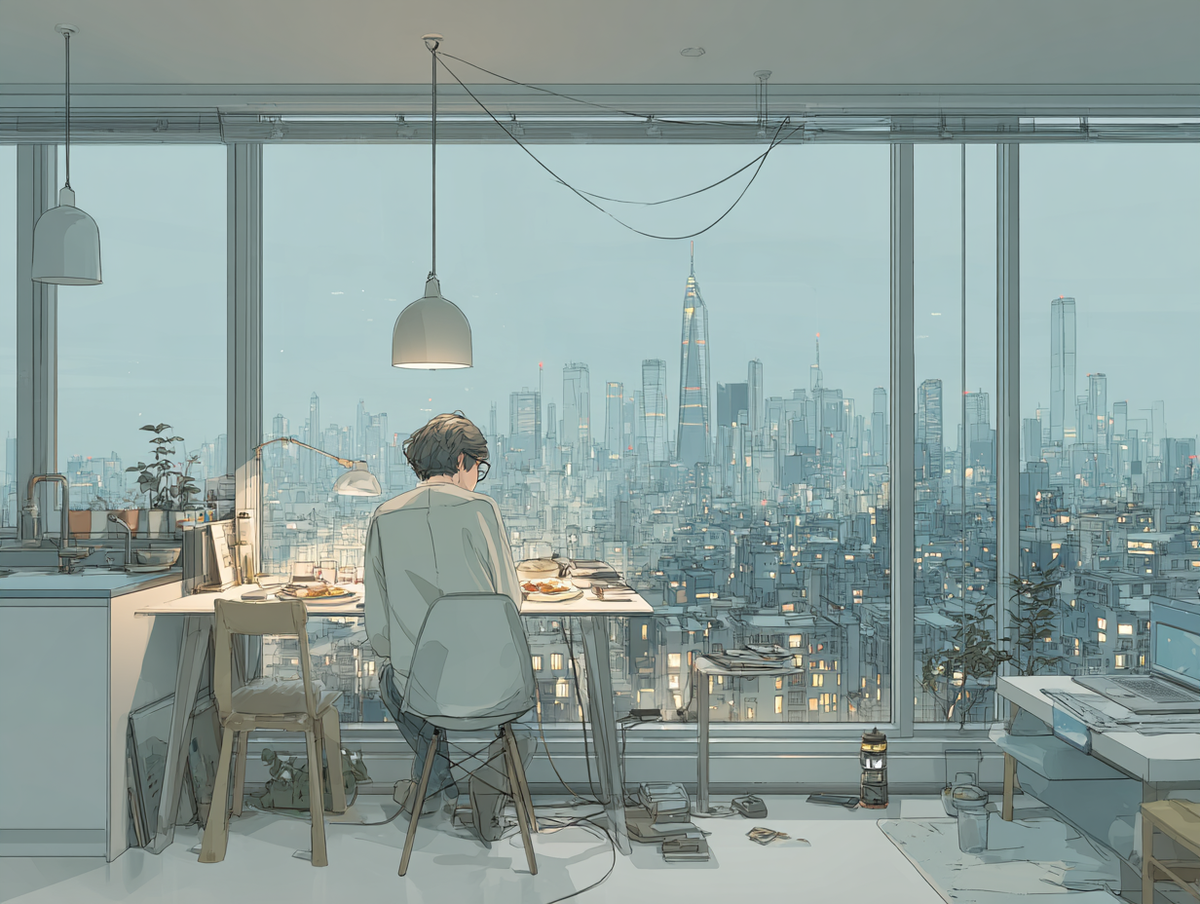
In South Korea, solo dining has moved from social awkwardness to everyday infrastructure in less than a generation.
Not long ago, walking into a restaurant alone required a certain amount of courage. People glanced around before taking a seat. Some would rather skip a meal than endure the quiet discomfort of eating by themselves in public. The unspoken question was easy to sense: “Do they have no one to eat with?”
Today, the scene looks entirely different. Restaurants with solo seats are no longer unusual. Convenience-store meals, food courts, ramen shops, delivery apps, meal kits, and office-district salad bars all serve a growing population of people who eat alone without hesitation. Solo dining is no longer a strange exception. It has become part of the everyday landscape.
At first glance, this looks like freedom.
Freedom to eat what you want.
Freedom to eat at your own pace.
Freedom from coordinating menus, schedules, moods, and conversations.
There is real comfort in that freedom. Eating alone can be peaceful. It can be efficient. It can even feel like a small act of self-possession in a world that constantly demands adjustment to others.
But the more important question is this:
Did we choose solo dining because our options expanded?
Or did solo dining become normal because the conditions for eating together disappeared?
At NEXTAGE, we do not see solo dining as merely a matter of taste. The dining table is one of the most ordinary settings in daily life. Precisely for that reason, it reveals how society is changing beneath the surface.
Solo dining appears to be a choice.
But perhaps what has expanded is not freedom itself,
but the infrastructure of living alone.
South Korea offers a particularly clear case. Single-person households now account for more than 40 percent of all households. This is not a minor demographic footnote. It has reshaped housing, retail, food delivery, restaurant design, and the emotional architecture of everyday life.
For people living alone, eating alone is not an event. It is breakfast, lunch, and dinner. It is the default rhythm of daily life.
The market has responded quickly. Single-serving menus, solo seating, convenience-store meal boxes, delivery platforms, and meal kits are increasingly designed around the individual consumer. The older standard — a table of four, shared dishes, large pots, side plates passed back and forth — is no longer the unquestioned norm.
This raises a deeper question.
Did the market simply adapt to the rise of solo dining?
Or did a market optimized for individuals make eating alone feel even more natural?
Structure and behavior reinforce each other. Once a society builds systems around the individual, individual behavior becomes easier, faster, and more convenient. Eventually, what began as adaptation becomes expectation.
And this is not only a Korean story. Across many advanced economies, people are eating at desks, in cars, in front of screens, or alone at home after a delivery app has replaced the shared kitchen. The form differs by country, but the direction is familiar: meals are becoming more individualized, more optimized, and less connected to social life.
Why Solo Dining Became the Default
The normalization of solo dining is driven by at least three overlapping shifts.
1. The communal table is disappearing
For generations, the dining table was one of the basic units of community. Families gathered, shared the events of the day, and quietly checked on one another without needing to say much. A meal was not only about food. It was a daily ritual of belonging.
That structure has weakened.
Families have become smaller. More people live alone. In some homes, the dining table itself has disappeared, replaced by a desk, a sofa, a phone screen, or a delivery box.
Solo dining did not emerge simply because people suddenly preferred isolation. It also emerged because many people no longer have someone physically present to eat with. In that sense, the density of relationships may have declined before the language of personal freedom expanded.
2. Modern schedules no longer align
Eating together requires synchronized time.
That sounds simple, but in modern life it has become increasingly difficult. Overtime, shift work, flexible hours, long commutes, school schedules, remote work, and different personal routines make shared meals harder to arrange. Even people living under the same roof often miss one another’s meal times.
A shared meal no longer happens naturally. It has to be planned.
And planning takes energy.
For people already exhausted by work, commuting, caregiving, or constant digital demands, coordinating a meal can feel like one more task. So people give up. They eat when they can, where they can, and as quickly as they can.
Solo dining is often chosen not because it is emotionally ideal, but because it requires the least coordination.
3. Efficiency has changed the meaning of a meal
Shared meals take time. They involve waiting, listening, adjusting, and slowing down. Eating alone is faster. The menu decision is simple. The pace is personal. There is no need to accommodate anyone else.
When efficiency becomes the organizing principle of life, food also changes meaning.
A meal becomes less of a social ritual and more of a refueling process. People eat to continue working, moving, scrolling, or managing the next obligation. The meal becomes functional. The table becomes optional.
In this sense, solo dining is not just a food trend. It is a visible symptom of a society that has reorganized daily life around speed, convenience, and individual optimization.
When Freedom Turns Into Isolation
Solo dining is not inherently negative.
There are days when eating alone is the best possible choice. It offers quiet. It removes the need to perform. It allows people to return to themselves. For some, a solitary meal may be the most peaceful moment of the day.
The problem begins when solo dining stops being a choice and becomes the default.
There is a profound difference between eating alone because you want to and eating alone because there is no one available, no time to coordinate, or no emotional energy left to reach out.
That difference determines whether eating alone feels like freedom or isolation.
A society should make room for both. It should respect the freedom to eat alone. But it should also preserve the possibility of eating together.
The danger is not the solitary meal itself. The danger is a world in which the shared meal becomes increasingly difficult to arrange, increasingly rare, and eventually unfamiliar.
Two Futures for Eating Alone
The future of solo dining seems to be moving in two directions at once.
On one side, solo dining will become more optimized. Food for single-person households will become more sophisticated. Restaurants will design better spaces for individuals. Delivery platforms will become more personalized. AI may recommend meals based on health data, mood, schedule, budget, and personal taste.
The solo meal will become smoother, faster, and more intelligent. It may even become more convenient than eating with others.
But on the other side, there are signs of a counter-movement.
People are rediscovering the value of eating together. Social dining groups, neighborhood kitchens, supper clubs, communal tables, and small gatherings for people living alone all point to the same desire. These are not just lifestyle experiments. They suggest that people are beginning to feel what optimized solo dining cannot provide.
Convenience can reduce friction.
It cannot replace presence.
The more society perfects the individual meal, the more some people may long for the imperfect warmth of a shared one.
The central question, then, is not whether solo dining should exist. It clearly should. The question is whether we will stop at making solo dining more convenient, or whether we will also rebuild the time, space, and relationships that make eating together possible.
Making solo dining easier
and making shared meals possible
are not the same project.
The market is very good at the first.
Society must take responsibility for the second.
What the Shared Table Still Means
There is nothing wrong with eating alone.
On some days, it is the most comfortable and honest choice. It can be a form of rest. It can be a boundary. It can be a small freedom.
But the current trajectory of solo dining suggests something larger. Eating alone is moving from occasional choice to structural condition. More people are not only choosing solitude; they are adapting to lives in which shared time has become difficult to find.
To eat together is to do more than share food. It is to share time, exchange the details of a day, and quietly confirm one another’s existence.
That is why the phrase “Let’s grab a meal sometime” carries more meaning than it appears to. It is rarely just about food. It is an invitation into time, attention, and relationship.
If that phrase begins to feel empty, then we are not simply witnessing a change in eating habits. We are witnessing a thinning of social connection.
Tonight, many people will eat alone. Some will sit in front of convenience stores. Some will eat in small apartments. Some will open a delivery box after a long day. Some will enjoy the silence completely. Others may suddenly remember the warmth of sitting across from someone else.
Food can be consumed alone.
But the warmth of a shared table is harder to manufacture.
The feeling of someone sitting across from you.
The simple question, “How was your day?”
The quiet gesture of passing a dish without saying anything.
Perhaps what we need now is not only a better solo meal.
Perhaps we need one person who can still ask:
“Shall we eat together today?”
As long as that question survives, we have not lost the ability to reach one another.
NEXTAGE | READING THE NEXT ERA