The Architecture of Healing: Why K-Chuna Could Become Korea’s Next Wellness Export
K-Beauty and K-Food changed the world. Now, explore K-Chuna—Korea's traditional manual therapy offering a biopsychosocial approach to modern chronic pain.


K-Beauty taught the world to think of skin as a system. K-Food introduced fermentation, balance, and microbial complexity to the global table. The next question is more intimate:
How does Korea understand the body—and how does it help the body recover?
This essay is the first in a series on Chuna, a Korean manual therapy rooted in traditional Korean medicine. But reducing Chuna to “Korean massage” would miss the point. Chuna opens a more interesting question for global readers:
Is chronic pain a problem of muscles, joints, nerves, posture, stress—or the way the entire body adapts to modern life?
Modern medicine no longer treats chronic pain as a simple mechanical fault in one isolated body part. Increasingly, it understands pain as a biopsychosocial phenomenon shaped by joints, fascia, the nervous system, inflammation, sleep, stress, movement habits, and the environments in which people work and live.
This is where Chuna becomes more than a cultural curiosity. It becomes a Korean case study in how traditional bodywork can be reinterpreted through contemporary medical and scientific language.
1. What Is Chuna?
The word Chuna comes from two Chinese characters: Chu, meaning “to push,” and Na, meaning “to grasp or pull.” At the simplest level, Chuna is a hands-on therapy that uses pushing, pulling, mobilization, and adjustment techniques to address imbalances in the musculoskeletal system.
In Korea, Chuna has developed within the framework of Korean medicine, where licensed Korean medicine doctors assess the body and apply manual techniques to the spine, joints, muscles, ligaments, and fascia.
For global readers, Chuna sits near several familiar fields:
- orthopedic manual therapy
- physical therapy and movement rehabilitation
- chiropractic spinal adjustment
- osteopathic whole-body approaches
- East Asian concepts of meridians and systemic balance
Yet Chuna is not identical to any of these. Its distinctive feature is that it has been institutionalized within Korea’s medical culture as a physician-led manual therapy. It is not simply spa treatment, folk massage, or relaxation therapy. It is part of a broader Korean medical worldview that links structure, movement, circulation, and whole-body function.
2. Why Chuna Matters Now: Modern Pain Is Structural
To understand Chuna, we first need to understand the modern body.
Millions of people now live in bodies shaped by screens, chairs, smartphones, long commutes, stress, and interrupted sleep. The consequences are subtle at first, then increasingly hard to ignore.
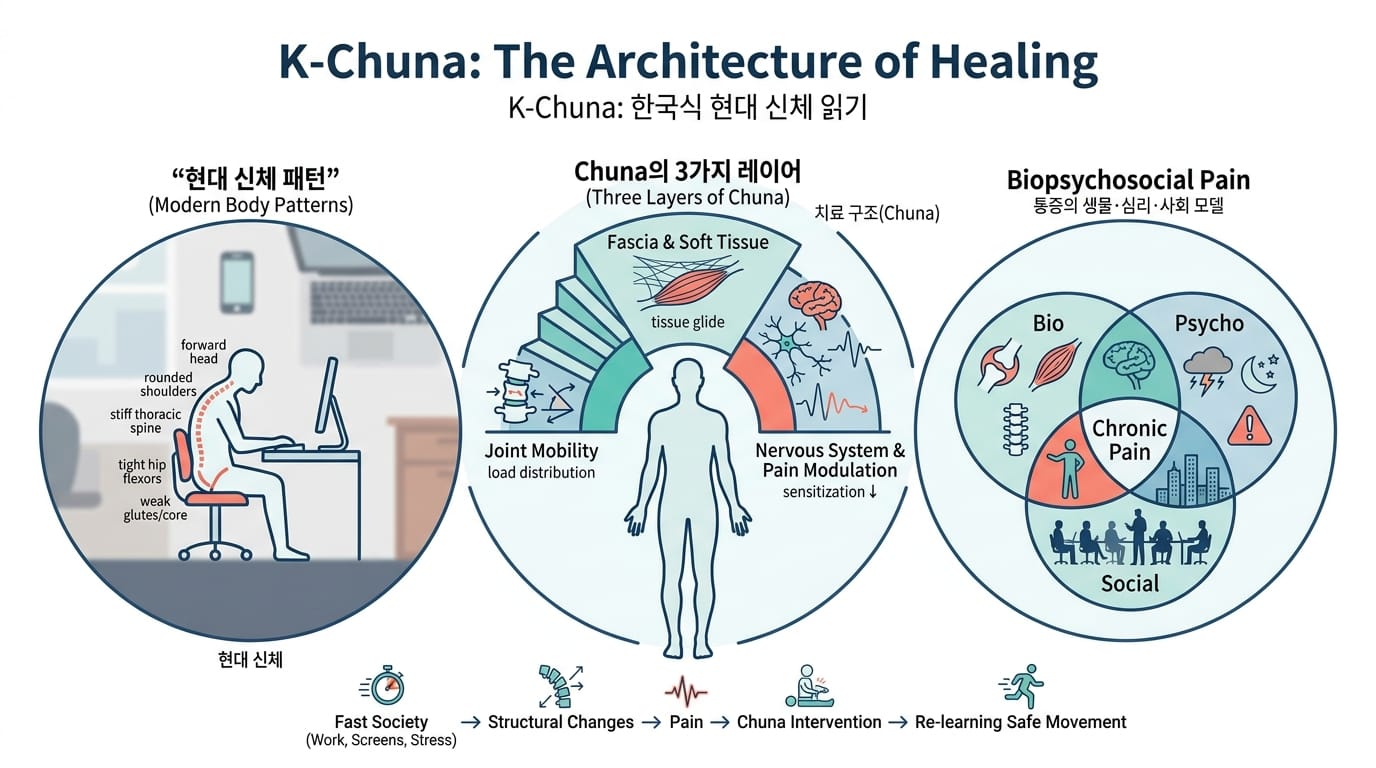
Common patterns include:
- forward head posture
- rounded shoulders
- stiff thoracic spine
- shortened hip flexors
- underactive glutes and core muscles
- chronic neck, shoulder, and lower-back tension
- shallow breathing patterns
- reduced range of motion
These are not merely cosmetic posture issues. They change how force travels through the body. They alter joint mechanics, muscle activation, breathing, balance, and even the way the nervous system interprets threat.
Pain often does not appear because one single structure suddenly “breaks.” It may emerge after months or years of compensation. One area loses mobility. Another area works too hard. The nervous system becomes more protective. The body adapts—until adaptation becomes pain.
Chuna is interesting because it looks beyond the painful spot. Neck pain may involve the thoracic spine, shoulder position, jaw tension, pelvic alignment, breathing habits, and work posture. Lower-back pain may not begin in the lower back at all.
In this sense, Chuna treats the body less like a collection of parts and more like an architectural system.
3. A Scientific Lens: Joints, Fascia, and the Nervous System
To translate Chuna into modern language, it helps to separate three layers.
First: Joint Mobility
A joint is not just a hinge between bones. It is also a sensory organ. It sends constant information to the nervous system about position, movement, pressure, and safety.
When a joint loses mobility, the body compensates. If the thoracic spine becomes stiff, the neck and lower back may absorb extra load. If the hips move poorly, the lumbar spine may overwork. Over time, compensation can become pain.
Chuna techniques that mobilize or adjust joints aim to restore more efficient movement and distribute load more evenly across the body.
Second: Fascia and Soft Tissue
Fascia was once treated as passive wrapping around muscles. Today, it is increasingly understood as a body-wide connective network involved in force transmission, movement coordination, and sensory perception.
Prolonged sitting, repetitive movements, injury, and stress may affect tissue glide, elasticity, and sensitivity. Manual stimulation may help modulate muscle tone, improve tissue mobility, and reduce perceived pain.
This does not mean that a practitioner simply “breaks up adhesions” in a crude mechanical sense. The more nuanced view is that manual therapy interacts with both local tissues and the nervous system that governs them.
Third: Pain Modulation
Chronic pain is not always proportional to tissue damage. The nervous system can become sensitized. Stress, fear, poor sleep, repeated pain experiences, and lack of movement can amplify pain signals.
Manual therapy may work partly by giving the nervous system a new experience: safe touch, restored movement, reduced threat, and a sense of control. In other words, the body may learn that certain movements are no longer dangerous.
From this perspective, Chuna is not simply about “putting bones back in place.” It is a structured conversation between the body’s architecture and the nervous system’s interpretation of that architecture.
4. Translating Traditional Concepts Without Mystifying Them
Traditional explanations of Chuna often refer to Qi, Blood, and meridians. For many global readers, these terms may sound mystical or unscientific. But the more useful question is not whether ancient language maps perfectly onto modern anatomy. It does not.
The better question is: What bodily experiences were these concepts trying to describe?
When traditional medicine says that the flow of Qi and Blood is blocked, a modern translation might point to several possibilities:
- restricted movement
- excessive muscle tension
- reduced local circulation
- altered tissue recovery
- heightened pain sensitivity
- disrupted breathing and autonomic balance
- loss of coordination across the body
This translation should be handled carefully. Traditional medicine and modern biomedicine come from different knowledge systems. They are not interchangeable. But both attempt to explain human suffering, bodily adaptation, and recovery.
The future of wellness will not be built by romanticizing tradition. It will be built by testing, refining, and translating traditional observations into language that is clinically useful, scientifically responsible, and globally understandable.
5. The Korean Context: A Fast Society, Slow Pain
Chuna is not only a therapy. It is also a window into Korea.
South Korea is one of the world’s most compressed modern societies: rapid industrialization, intense education, long work hours, digital density, beauty culture, performance pressure, and relentless self-optimization.
That social rhythm leaves marks on the body.
It produces bodies that sit for long hours, endure fatigue, suppress discomfort, and keep functioning. Neck pain, shoulder tension, back pain, headaches, and chronic stiffness are not just personal problems. They are physical signatures of a society organized around speed.
This is the paradox of Chuna in Korea. In one of the world’s fastest societies, healing often begins by slowing down enough to read the body again.
For global readers, this is not a uniquely Korean problem. The same body is appearing in New York, London, Singapore, Berlin, Seoul, and anywhere digital work has become the default. Work has globalized. Screens have globalized. Pain has globalized too.
That is why Chuna matters beyond Korea.
6. What Chuna Can—and Cannot—Claim
For Chuna to become globally credible, it must avoid the language of miracle cures.
Chuna may be relevant for certain musculoskeletal conditions, postural imbalance, joint dysfunction, movement restriction, and some functional symptoms. But it is not a universal solution. Acute fractures, infections, tumors, severe neurological symptoms, progressive inflammatory disease, and vascular red flags require conventional medical evaluation.
The evidence base for Chuna is growing, but more rigorous research is needed. Important questions remain: Which conditions respond best? Which techniques are most effective? How durable are the outcomes? How does Chuna compare with physical therapy, chiropractic care, osteopathy, exercise therapy, or standard medical treatment?
This is not a weakness unique to Chuna. It is the necessary pathway for any traditional or manual therapy entering a global medical conversation.
Good wellness writing should not sell certainty where evidence is still developing. It should ask better questions.
7. Why This Is Only the Beginning
This essay is an introduction. It frames Chuna not as an exotic wellness trend, but as a Korean approach to the modern body—one that deserves to be examined through anatomy, neuroscience, pain science, cultural context, and evidence-based medicine.
The next essays in this series can go deeper:
- How is Chuna different from chiropractic care, osteopathy, and physical therapy?
- What actually happens during a spinal adjustment?
- Does manual therapy change body structure, nervous-system signaling, or both?
- How much of its effect comes from touch, expectation, movement, or placebo?
- Can Korean medicine find a credible place in the global integrative medicine market?
- Could K-Wellness become the next Korean cultural export after K-Beauty and K-Food?
Chuna is not just a technique performed by hand. It is a way of reading the modern body.
And perhaps, in a world that has learned to move too fast, that may be exactly why it is worth understanding.